
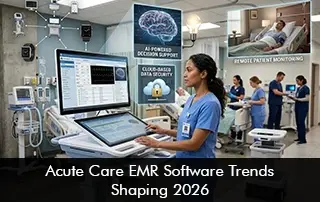
Interestingly, the acute care EMR Software market is entering a new phase in 2026. For a few years now, hospitals are not only considered about digitization of patient records but also prioritize intelligent automation, interoperability, and AI-propelled decision-making. Healthcare organizations are under the increasing pressure of rising costs, demand for better healthcare, staffing shortages, and reimbursement challenges.
The acute care EHR software market in the USA is mainly dominated by three key players: Epic Systems, Oracle health, and MEDITECH EMR System. These vendors are investing in AI workflows and robust interoperability to empower hospitals.
AI-Native acute Care EMR Systems on the Rise
AI has all the spotlight in 2026 and beyond. Modern Electronic Medical Records (EMR) Software vendors like Epic EHR software are embedding AI into acute care workflows. This is great news for clinicians, as artificial intelligence tools can automate and streamline tedious documentation processes and simplify many administrative tasks to alleviate the chronic issue of physician burnout.
AI solutions are aiming to enhance not only clinician documentation but also coding, RCM, discharge planning, and predictive analytics.
Stronger Interoperability
Interoperability has always been a challenge. Good news: in 2026 EHR systems are changing for the better. Acute care EMR software vendors are taking interoperability seriously and are ensuring they adhere to TEFCA frameworks and FHIR APIs for seamless data exchange that can result in high-quality patient care.
Hospitals expect their EMR system to integrate smoothly with labs, telehealth, imaging systems, wearable devices, and third-party applications to bridge data silos and offer holistic and personalized patient care.
Robust interoperability is especially critical for acute care as patients move between emergency rooms and inpatient units, see specialty providers, and visit post-acute care settings. Gaps in care can lead to detrimental issues of medical errors and delays.
Cloud-based Deployments Accelerate in Acute Care EMR Software
One of the major trends we are seeing is that the hospitals are transitioning away from legacy systems and on-premise solutions. The power of the cloud is driving this shift. Cloud-based platforms have proved that they are scalable and offer enhanced security and flexibility, which is the need of healthcare today. Cloud solutions also enable efficient remote care operations and even turn out to be cost-effective.
Predictive Analytics is now essential
Predictive analytics tools are directly available inside acute care EMR software systems. Hospitals are leveraging predictive analytics broadly in 2026 to enhance operational and clinical processes. Predictive models can help providers take a proactive role in healthcare by swift identification of high-risk patients and even patients that have greater chances of hospital readmissions.
The Acute Care EMR Software is Becoming Consolidated
The acute care software market is continuing to become consolidated. Reports show Epic Systems continues to dominate the market, with competition coming from MEDITECH and Oracle Health software.
The economic pressure and uncertainty is postponing hospitals to move forward with large scale EMR Software replacement decisions. For now healthcare organizations are focused in optimizing their existing platforms for modern healthcare delivery.